
Football’s Injury Time Law This is one of the points that often puzzles fans, especially when the match time unexpectedly extends. Understanding this rule helps players grasp the match’s progress more fully and rationally assess possible scenarios at the end of each half.
The rules of competition govern the calculation of added time
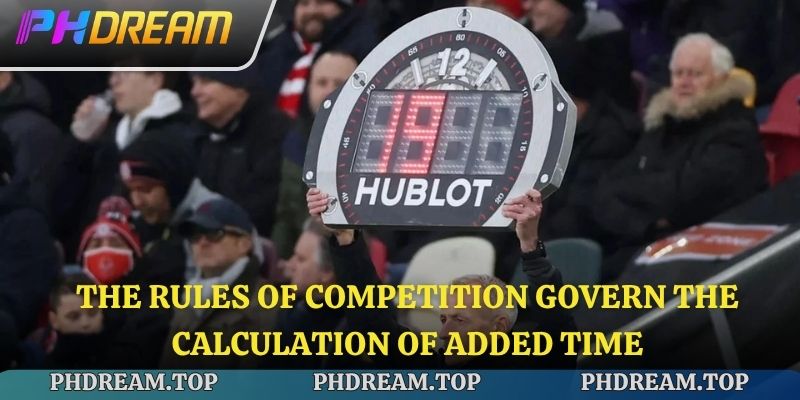
To understand correctly Football’s Injury Time Law Spectators need to understand the basis on which referees determine the number of minutes added after each official half of the match.
Based on the duration of the match interruption
During a match, situations such as substitutions, player injuries, VAR checks, or time-wasting all reduce the actual playing time. The referee will record these interruptions and add them to the end of the half. The amount of added time is not fixed but depends on the number of incidents that occur during that half.
Injury time should not exceed the necessary limit
Although various incidents can occur, the total added time must still be reasonable. The main referee has the right to decide the number of minutes of added time after consulting with the assistant referees and the fourth official. In special cases such as a long stoppage due to disputes or equipment changes, the added time may be longer than usual. This is an important point to understand when studying the subject. Football’s Injury Time Law According to current law.
Each half can have extra time
Both halves of a match are considered for added time. The first half is usually shorter, averaging 1 to 3 minutes, while the second half typically lasts between 3 and 7 minutes. Matches with more controversial incidents, numerous substitutions, or extended VAR use will have higher added time.
Situations that often cause compensatory time
Accurate identification Football’s Injury Time Law Specific situations that arise on the field need to be considered. Below are common reasons why matches are extended and affect added time.

The player is injured
One common reason is when a player suffers an injury and requires medical attention. Depending on the severity and duration of the stoppage, the referee will add a corresponding number of minutes to the end of the half.
The substitution process was lengthy
Each substitution typically takes about 30 seconds to 1 minute. If there are multiple substitutions in a half, the total time lost will be added up. The referee will closely monitor these substitutions to ensure fairness when calculating added time.
Waiting time for VAR check
When a situation requires a review using VAR, the main referee can temporarily stop the game to make an accurate decision. These periods usually last from 1 to 3 minutes, depending on the nature of the incident. Therefore, in important matches or those with contested situations, the added time may be longer than usual.
The player was wasting time
Some teams employ tactics to slow down the pace of the game by wasting time. Actions such as delaying the kick-off, staying on the ground longer than necessary, or making substitutions when time is running out are all recorded and penalized accordingly. Those who want to understand this in more detail… Football’s Injury Time Law Pay attention to this detail because it often appears in the late stages of the game.
Special regulations regarding extra time

In addition to the basic elements, there are some specific regulations to be aware of for a more comprehensive understanding. Football’s Injury Time Law These are the rules applied in certain matches or major tournaments.
Injury time in extra time
In knockout matches, if the winner is not determined after 90 minutes of regulation time, two extra time periods will be held, each lasting 15 minutes. This time may also be extended if special circumstances arise, although it usually does not exceed 2 minutes per period.
The time allotted for a dead ball is not calculated precisely to the second
In reality, referees don’t add up every single second precisely, but rather use an overall estimation. Therefore, even if there’s a brief stoppage lasting only a few tens of seconds, the referee may not include it in the calculation if they deem the impact insignificant. Viewers need to understand this principle to avoid questioning why the added time sometimes doesn’t match the prediction.
The referee can extend the time if necessary
Even if the announced injury time is 5 minutes, the referee can still extend it if a significant incident occurs during that time. For example, if an injury occurs in the third minute of injury time, the total time could reach 97 minutes even though the scoreboard only shows 5 minutes. This is very common and is ultimately at the discretion of the main referee.
Conclude
Understand Football’s Injury Time Law This helps you follow the match fully and understand the events unfolding on the field. By understanding the principle of time addition, viewers can better predict the outcome of the match, especially in tense and unpredictable games at Phdream.